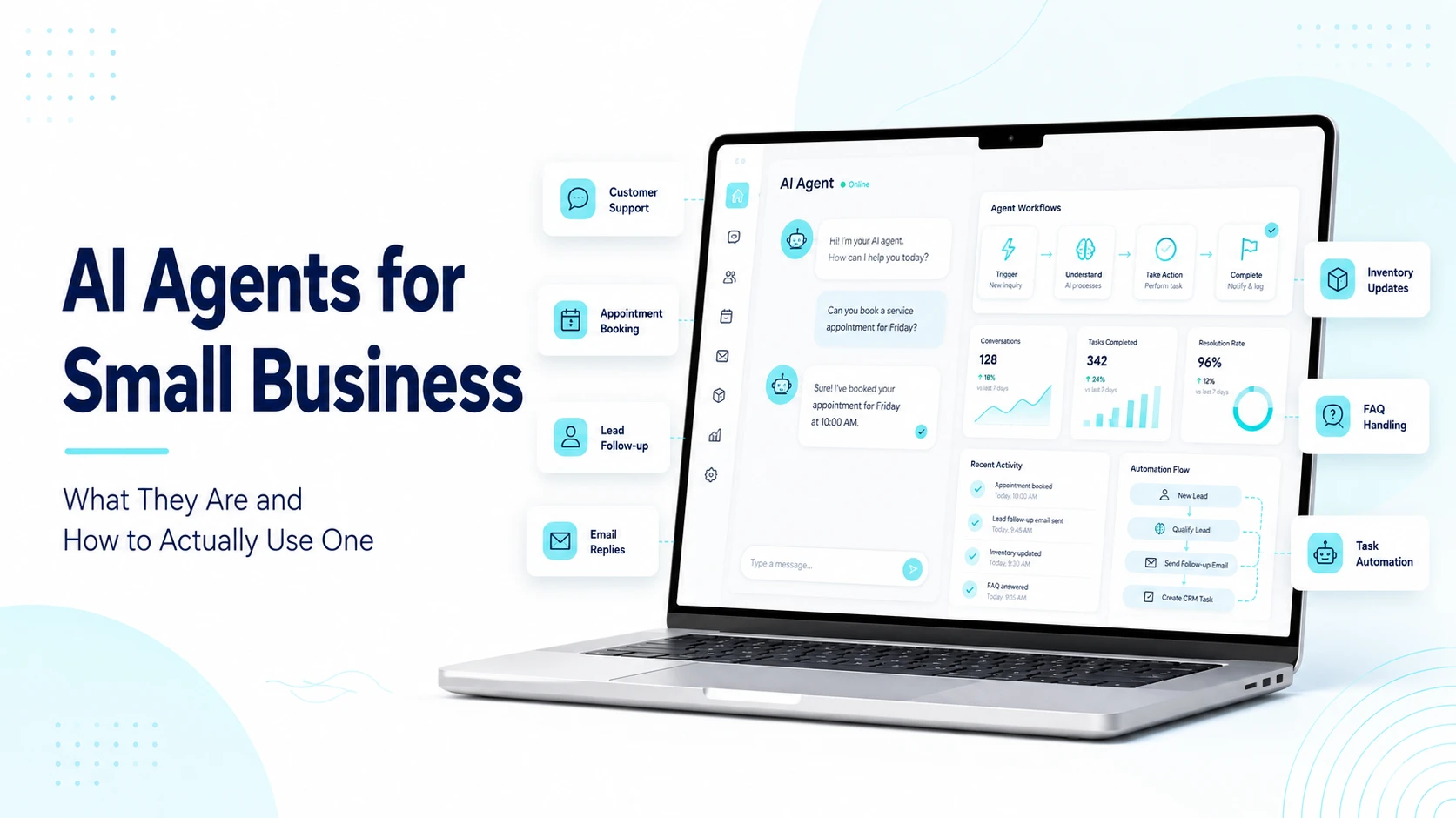
“AI agents” has become one of the most talked-about terms in business technology, but the concept often gets buried under enterprise case studies and jargon that don’t translate to how a small business actually operates. Stripped of the hype, an AI agent is a genuinely useful tool for a small team — but only when applied to the right kind of problem.
This guide explains what an AI agent actually is, how it’s different from a basic chatbot or automation, and where small businesses are getting real value from them right now.
What Is an AI Agent, Really?
An AI agent is a system that can understand a goal, decide on steps to reach it, and take action across multiple tools — without a human manually directing each step. That’s the key difference from older automation and even basic AI chatbots.
To make the distinction concrete:
- A chatbot answers a question when asked.
- A basic automation (like a simple Zapier workflow) follows a fixed, pre-set sequence of steps every time, with no real decision-making.
- An AI agent can look at a situation, decide what needs to happen based on context, take multiple actions across different tools, and adjust based on what it finds along the way.
A simple example: a basic automation might notify you when a new lead fills out a form. An AI agent could read that lead’s message, judge how urgent or qualified it is, draft a personalized reply, update your CRM with the right tags, and flag it for follow-up — all without a fixed script dictating every step in advance.
Why This Matters for Small Businesses Specifically
Enterprise companies have had access to this kind of technology for a while, often through expensive, custom-built systems. What changed recently is that AI agent tools have become accessible and affordable enough for a small business to realistically use — no dedicated engineering team required.
A few real shifts that made this practical:
- Off-the-shelf agent platforms now handle much of the technical complexity, so setup is closer to configuration than custom software development.
- Integration with everyday small-business tools — CRMs, email, helpdesks, e-commerce platforms — is far more mature than it was even a year or two ago.
- Cost has dropped significantly. Running an AI agent for common tasks now costs a small fraction of what it did previously, making it viable even for modest-sized teams.
Where Small Businesses Are Actually Using AI Agents
1. Customer Support Agents
Rather than a rigid FAQ chatbot, a support agent can understand a customer’s actual question, check order status or account details, resolve common issues directly, and escalate genuinely complex cases to a human — with context already gathered.
2. Lead Qualification and Follow-Up
An agent can review incoming leads, judge fit and urgency based on what they’ve written, personalize an initial response, and schedule appropriate follow-ups — reducing the delay between a lead coming in and a meaningful first response.
3. Internal Research and Reporting Agents
Instead of a team member manually compiling a weekly performance summary from five different tools, an agent can pull the relevant data, summarize it clearly, and deliver it automatically — adjusting what it reports on as your questions change.
4. Content and Social Media Agents
An agent can monitor themes and topics relevant to your business, draft social posts or content ideas in your brand voice, and prepare them for review — going further than a simple scheduling tool by actually generating relevant material.
5. Sales and CRM Agents
Agents integrated with a CRM can track deal activity, draft follow-up emails at the right moments, and flag deals that have gone quiet — acting more like a proactive assistant than a passive database.
How AI Agents Are Different from What You Might Already Have
If you’ve already set up automations using tools like Zapier or Make, it’s worth understanding exactly where an agent adds something new. A standard automation follows the same fixed path every single time: “if X happens, then always do Y.” An agent, by contrast, can handle situations that don’t fit a single fixed pattern — judging context, choosing between several possible actions, and adapting when something unexpected comes up.
This doesn’t make traditional automation obsolete. For simple, entirely predictable tasks, a basic automation is often faster to set up and easier to trust. Agents earn their value on tasks that involve judgment calls a fixed script can’t anticipate.
How to Get Started Without Overbuilding
The most common mistake with AI agents isn’t choosing the wrong tool — it’s trying to hand over too much responsibility too soon. A safer, more effective approach:
- Pick one task that currently requires judgment, not just repetition — something a competent employee would need to think about, not just follow a checklist for.
- Keep a human reviewing the agent’s output for the first few weeks, rather than letting it act fully autonomously from day one.
- Start with a narrow scope. An agent that handles one type of customer inquiry well is more valuable early on than one attempting to handle everything at once.
- Expand gradually, adding scope only once you trust the results on the first use case.
Common Concerns Worth Addressing Honestly
Will it replace my team? In most small businesses, agents take over specific repetitive-but-judgment-based tasks within a role, freeing people for the parts of the job that genuinely need a human — not replacing the role outright.
What if it makes a mistake? This is exactly why a review step matters early on. Most businesses run agents with human oversight for a period before trusting them with fully autonomous decisions, especially on anything customer-facing or financial.
Is this expensive to set up? Costs vary, but starting with a single, well-scoped agent using existing platforms is typically far more affordable than a custom-built system — and can usually be set up in days, not months.
Is It Worth It Right Now?
For a specific, well-chosen task, yes — the businesses seeing real value are the ones that treat agent adoption like hiring: solve one clear problem well before expanding scope, rather than attempting to automate an entire department at once. Getting an early, well-scoped agent working reliably tends to matter far more than which specific platform you choose.
Frequently Asked Questions
What’s the difference between an AI agent and a chatbot? A chatbot typically answers questions when asked. An AI agent can take multi-step action across different tools based on judgment about the situation, not just respond to a single prompt.
Do I need a developer to set up an AI agent? For many common use cases, no — modern agent platforms are built to be configured without custom code. More complex, highly specific workflows may still benefit from developer involvement.
What’s a good first AI agent project for a small business? Customer support or lead response are common starting points, since they’re high-volume, repetitive-but-judgment-involving tasks where a fast, reasonably accurate response matters more than perfection on day one.
Braincelo designs and builds AI agents and automation workflows for growing businesses, connecting the tools you already use so your team spends less time on repetitive work. If you’re curious how this fits alongside broader AI search visibility, that’s worth reading too. Book a free call to talk through where an AI agent could fit into your business.
Found it useful? Pass it along.
 READ
READ  READ
READ  READ
READ